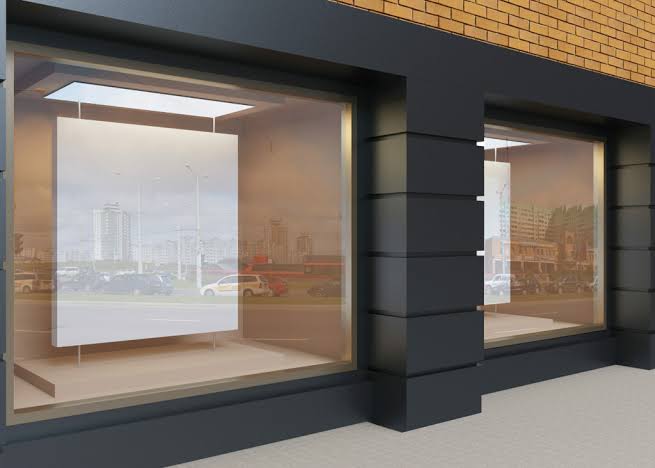
A storefront window does more than provide a view into a business.
It sits directly between the company and the people passing outside. Before a customer enters, the glass may already be communicating the business name, hours, services, promotions, products, policies, or simply enough visual branding to make the location recognizable.
That does not always require covering the entire window.
For many businesses, smaller window decals, lettering, logos, and printed graphics provide a more flexible way to use glass while keeping much of the storefront open.
A restaurant may need hours and a logo near the entrance. A salon might display services. A retailer may rotate seasonal promotions. An office can add identification without blocking natural light. A new location may need temporary opening graphics before permanent signage is complete.
The most useful window graphic programs usually begin by deciding what customers need to know—and where they need to see it.
A Storefront Window Can Perform Several Jobs at Once
One piece of glass may have multiple communication roles.
From across the street, a customer may need to recognize the business.
As they approach, they may want to understand what the company sells or does.
At the entrance, they may look for operating hours, contact information, or instructions.
This means window graphics can be organized according to different viewing distances rather than treating every message as equally important.
Possible uses include:
company logos;
business names;
operating hours;
service descriptions;
promotional messages;
product information;
seasonal campaigns;
QR codes;
directional information;
opening announcements;
privacy elements;
decorative graphics.
The challenge is not finding enough information to place on the window.
It is deciding what deserves the space.
The Business Name Does Not Need to Be Repeated Everywhere
Many storefronts already have a primary exterior sign.
The company name may appear above the entrance in channel letters, dimensional lettering, an awning, a sign cabinet, or another permanent sign.
Repeating that same information across every window can waste valuable communication space.
Window decals can instead support the primary sign.
The main exterior sign identifies the business from farther away.
The windows can then handle secondary information such as:
services;
promotions;
products;
hours;
supporting brand elements.
This creates a hierarchy instead of making every surface compete for attention.
Door Graphics Have a Different Job From Window Graphics
The entrance is one of the most valuable pieces of glass in a storefront.
Customers naturally approach it closely.
That makes the door a good location for detailed information that would be difficult to read from farther away.
Common door graphics include:
business hours;
website;
phone number;
suite number;
social handles;
small logos;
entry instructions.
These details do not necessarily belong on the largest storefront window.
A person viewing the business from across the street does not need to read the opening hours.
Someone standing at the door does.
Matching information to viewing distance helps keep the entire storefront cleaner.
Smaller Graphics Preserve Visibility Into the Business
One advantage of decals over full window coverage is that businesses can continue using the glass as glass.
Customers can see merchandise.
Natural light can enter.
Employees maintain outward visibility.
Restaurants can retain views into the dining area.
Retail stores can allow window displays to remain visible.
A logo, lettering, or printed graphic can occupy only the area needed for communication while leaving the rest of the window open.
That balance is especially useful when what happens inside the business is itself part of the marketing.
A busy restaurant can look inviting.
A well-designed retail interior can encourage someone to enter.
A showroom benefits from visible products.
Covering the entire window would work against that objective.
Retail Windows Need to Change More Often Than Permanent Signs
A permanent storefront sign may remain in place for years.
Retail campaigns often do not.
Seasonal sales, new products, holiday campaigns, grand openings, special events, and limited-time offers create a different type of graphics requirement.
Window decals can allow the permanent storefront identity to remain while selected messages change.
A retailer might maintain:
a permanent logo;
permanent operating hours;
long-term decorative graphics;
while replacing:
promotional decals;
seasonal messages;
product graphics;
campaign artwork.
Treating permanent and temporary information differently makes future updates easier.
Temporary Does Not Mean Unplanned
Short-term graphics still require planning.
The expected installation period influences material selection.
A graphic intended for several weeks may not need the same adhesive characteristics as one expected to remain for several years.
Removal also matters.
The business should consider:
how long the graphic will remain;
whether it will be replaced;
whether adhesive residue is acceptable;
whether the glass is interior or exterior;
exposure to weather;
how frequently campaigns will change.
Planning the removal before installation can prevent a temporary promotion from becoming a permanent cleanup problem.
Cut Vinyl Lettering Works Well for Simple Information
Not every window graphic needs to be digitally printed.
Cut vinyl is commonly used for solid-color lettering, logos, hours, numbers, and simple shapes.
The unwanted vinyl is removed during production, leaving only the intended letters or graphic elements.
After installation, the glass remains visible around the design.
This approach works particularly well for:
operating hours;
business names;
simple logos;
phone numbers;
web addresses;
door lettering;
service lists.
The result can look clean because there is no visible rectangular background around the graphic.
Printed Decals Allow More Complex Artwork
Some designs require more than solid-color vinyl.
Printed decals can reproduce:
photographs;
illustrations;
gradients;
multiple colors;
detailed brand artwork;
promotional designs.
The printed graphic may be contour cut into a specific shape rather than remaining a simple rectangle.
This allows businesses to place detailed campaign artwork on glass without committing to a full window wrap.
A retailer could install individual product images.
A restaurant might add illustrated graphics.
A children’s business may use colorful characters or decorative elements.
The production method should follow the artwork rather than forcing every design into the same type of vinyl.
White Ink, Transparency and Glass Can Affect the Design
Designing for glass introduces a consideration that does not exist on an opaque sign panel.
The background can change.
A graphic may be seen against a brightly lit interior during the day and a darker space at night.
Objects behind the glass may influence how colors appear.
Transparent portions of artwork interact with whatever is visible behind them.
Some printed applications may require white layers or opaque areas so colors remain strong rather than becoming translucent.
The designer needs to consider how the graphics will behave on actual glass, not just how the artwork looks on a white computer screen.
Contrast Determines Whether Lettering Can Be Read
A storefront may have attractive graphics that are still difficult to read.
Contrast is one of the main reasons.
Dark lettering placed on glass may disappear against a dark interior.
Light lettering may become difficult to see against bright displays.
What appears behind the window changes throughout the day.
Businesses should consider:
interior wall colors;
lighting;
displays;
merchandise;
shadows;
reflections;
exterior surroundings.
Sometimes adding an outline, background element, or different vinyl color can make the information substantially easier to read.
Reflections Compete With Window Graphics
Glass reflects the street.
Cars, buildings, sky, lights, trees, and pedestrians may all appear across the same surface carrying the graphics.
This visual competition is easy to overlook when designing artwork separately from the storefront.
Fine text and low-contrast colors can become particularly difficult to read.
Larger forms, stronger contrast, and simpler information often perform better.
The window itself is not a neutral background.
It is an active visual surface.
Too Much Service Information Can Hurt Readability
Service businesses often want to list everything they do.
A window can quickly become a paragraph.
For example, a contractor may offer ten services. A salon may have a long treatment menu. A print shop may produce dozens of products.
Listing every service at equal size often makes none of them easy to understand.
A better approach may be to group services into categories or highlight the most commercially important ones.
The customer does not always need the complete service catalog from the sidewalk.
They need enough information to understand the business.
Information Should Be Prioritized by Distance
A useful storefront can be thought of in layers.
Long Distance
At this level, graphics should be simple.
Useful information may include:
logo;
business name;
one major service category;
recognizable brand color or symbol.
Medium Distance
As pedestrians approach, more information becomes readable.
This can include:
service categories;
promotional messages;
product information;
supporting branding.
Close Distance
At the door or directly beside the window, customers can read:
hours;
contact information;
detailed notices;
QR codes;
instructions.
This hierarchy prevents every message from needing to be oversized.
Window Graphics Can Help New Businesses Before Opening
A storefront may need to communicate before the business is ready to operate.
Construction can last weeks or months.
Without graphics, people passing the location may see only empty glass, paper, or an unfinished interior.
Temporary decals can announce:
the company name;
opening date;
website;
social accounts;
hiring information;
“coming soon” messages.
This allows the location to begin building recognition before the doors open.
Once the business launches, temporary graphics can be replaced with the permanent storefront system.
Existing Graphics Need Proper Removal
Businesses frequently inherit glass that already contains vinyl.
It may belong to a previous tenant.
It may be an outdated promotion.
It may simply no longer match the current brand.
Removing the old graphic is part of preparing for the new one.
Vinyl can leave adhesive residue, particularly after long periods of exposure.
The glass should be properly cleaned before new graphics are installed.
Layering new decals directly over old material can create visible edges, uneven surfaces, and adhesion problems.
The quality of the new installation begins with the condition of the glass underneath it.
Glass Should Be Prepared Even When It Looks Clean
Windows are cleaned regularly, but a surface that looks clean is not necessarily ready for vinyl.
Glass may contain:
dust;
oils;
fingerprints;
cleaning-product residue;
adhesive;
environmental contamination.
These contaminants can interfere with adhesion.
The installation area needs appropriate preparation before vinyl is applied.
This becomes particularly important with small cut lettering, where each individual element has less adhesive surface area than a large printed graphic.
Accurate Placement Matters More With Simple Designs
Simple graphics expose alignment errors.
A large photograph contains enough visual detail that a small positioning difference may not attract attention.
A row of clean lettering does not.
If business hours are slightly crooked, people notice.
If a logo is visibly off-center on the door, people notice.
If two windows contain graphics at different heights, people notice.
Professional installation often involves measuring and temporarily positioning the graphics before final application.
The simpler the design, the less there is to hide poor alignment.
Storefront Mullions Can Help Organize Information
A series of windows does not need to be treated like one continuous canvas.
Frames and mullions naturally divide the storefront into sections.
Those divisions can help organize information.
One pane may carry the logo.
Another may identify services.
A third can feature a promotion.
The door can hold business hours.
Using the architecture this way can make the storefront easier to understand.
It also allows individual sections to be changed later without redesigning everything.
Promotional Graphics Should Not Hide the Entrance
Temporary campaigns often become visually dominant.
A retailer may install a large sale graphic.
A restaurant may promote a new offering.
A fitness studio might advertise a membership campaign.
The campaign still needs to respect basic storefront usability.
Customers should immediately understand where to enter.
Door handles, entry areas, important identification, and sightlines should remain clear.
A promotional message that makes the storefront confusing is working against the business.
Window Graphics Can Coordinate With Interior Graphics
The glass is part of a larger environment.
A customer may see window decals outside, walk through the entrance, and then encounter wall graphics, directional signs, dimensional logos, or other interior elements.
Using similar typography, colors, icons, and visual treatments makes that transition feel deliberate.
The same design does not need to be repeated exactly.
Consistency can come from a common visual language.
This helps connect the storefront to the experience inside.
Different Businesses Need Different Levels of Information
There is no single formula for a good window decal program.
A restaurant may need:
logo;
hours;
cuisine type;
reservation information.
A professional office may need only:
company name;
suite information;
hours.
A retailer might rely heavily on:
promotions;
product graphics;
seasonal messaging.
A service business may prioritize:
primary services;
contact information;
service area.
The best use of glass depends on what someone needs to understand before deciding to enter or contact the business.
Updating Individual Graphics Can Extend the Life of the Storefront
One advantage of a modular window graphic system is that every change does not require replacing everything.
Operating hours can be updated.
A promotion can be removed.
A new service can be introduced.
A seasonal graphic can be swapped.
The core identity can remain intact.
This allows the storefront to evolve over time without constantly redesigning the entire glass surface.
Businesses planning custom graphics for glass can benefit from thinking of permanent branding and changing information as separate layers from the beginning.
That makes future updates easier to manage.
Good Window Graphics Make Information Easier to Find
A successful window decal project does not need to make customers consciously admire the vinyl.
Its job may be much simpler.
Someone walking past understands what the business does.
A customer finds the hours without searching.
A promotion is visible without obscuring the store.
The entrance remains obvious.
The branding feels consistent with the primary sign and the interior.
When that happens, the graphics are doing their job.
The storefront glass is still glass.
It simply communicates more than it did before.